Why four tracks do not sound like the originals
Four tracks, four house acts, and a licensing rule that has been in the series for over a decade.
Four tracks in Just Dance: Decades of Hits use re-recorded vocals rather than the original masters: ABC (credited to Groove Century), Celebration (Equinox Stars), Come and Get Your Love (The Heartliners) and Jump (Metal Russell). The covers exist because the original recordings were not licensable for the game.
One of the most frequent first-week comments on any Just Dance release is that a track "sounds off". In this game there are four of them, and there is a consistent reason.
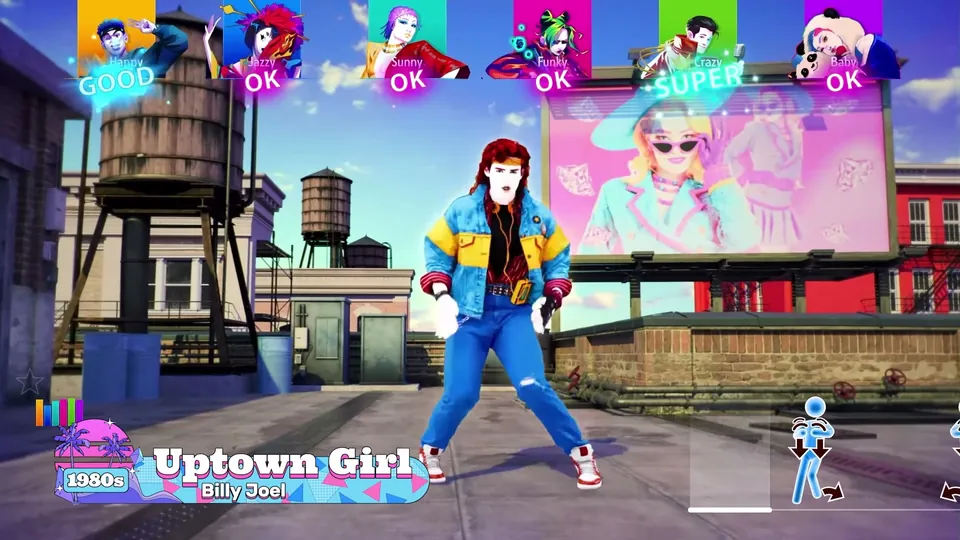
Official Ubisoft in-game screenshot.
The four covers
| Track | Decade | Credited act | Routine |
|---|---|---|---|
| ABC | '70s | Groove Century | Trio |
| Come and Get Your Love | '70s | The Heartliners | Trio |
| Jump | '80s | Metal Russell | Solo |
| Celebration | '80s | Equinox Stars | Solo |
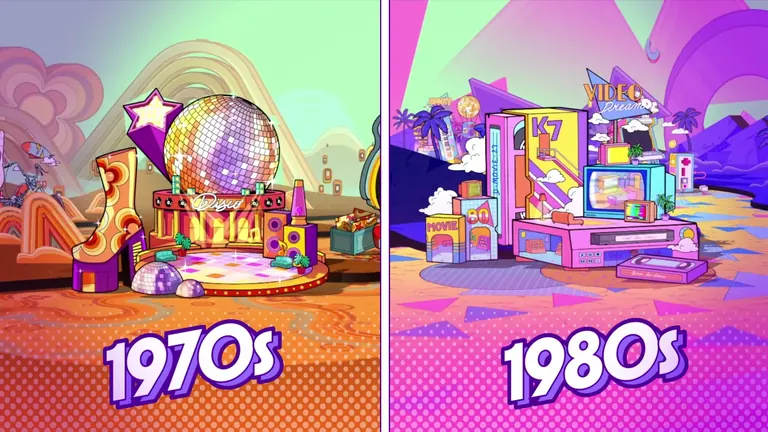
Notice the pattern: all four come from the two oldest blocks. That is not a coincidence, and it is also why the '70s and '80s pages both flag their covers explicitly — see the '70s song list and the '80s song list.
Why it happens
Licensing. Older recordings are often controlled by a different rights holder than the songwriting, and the master recording — the actual performance you hear on the single — is the expensive part. When the master is not available on terms the developer can work with, the alternative is to re-record the song with a house vocalist and license the composition instead.
This is not new and not specific to this game. The Just Dance series has used in-game covers since its earliest entries, which is why certain songs have always sounded slightly different in the game than on the radio. Decades of Hits is unusual only in that its oldest heavy blocks push the count up to four.
What a cover changes, and what it does not
What changes: the vocal performance. Different singer, sometimes a different mix, occasionally a slightly different arrangement of the same composition.
What does not change: the song structure the choreography is built on. A routine's phrase list follows the tempo and the arrangement, so the game can use a cover without touching the dance. That is why Jump plays exactly as hard as it ever did despite the different vocal.
What it means for you: nothing mechanical. Covers do not change scoring, difficulty, routine type or availability. If you were looking for a reason a routine feels different, the vocal is not it — the difficulty page is where to look.
Is it a problem?
Only if you were buying the game as an album. As a dance game, the trade-off is worth stating plainly: without the covers, four of the game's most recognisable older tracks would not be in the game at all. Two of them — ABC and Come and Get Your Love — sit on the Adventure Mode path, so the alternative to a cover was an empty slot in the campaign.
That is the honest framing. A cover is the version of a song you get when the alternative is no song.
How to tell what you are hearing
The game's own song list credits the performer, which is why the tracklist on this site shows names like "The Heartliners" and "Equinox Stars" in parentheses after a familiar artist. If a credit on the song select screen is not the artist you expected, you are looking at a cover — and the full song list lists all 35 tracks with the same credit convention.