The songs to learn first, in order
Twelve routines ordered so that each one teaches the next.
Start with Uptown Girl, then Coconut, Mamma Mia and Bye Bye Bye. Move on to the 2000s block, the '90s duets and the 2010s, then finish with the 2020s. The order matters because the early routines teach the arm shapes and lane-reading that the harder blocks assume.
There is no tutorial in Decades of Hits beyond Adventure Mode, and Adventure Mode teaches you by escalating rather than by explaining. This is the same ladder, written out.
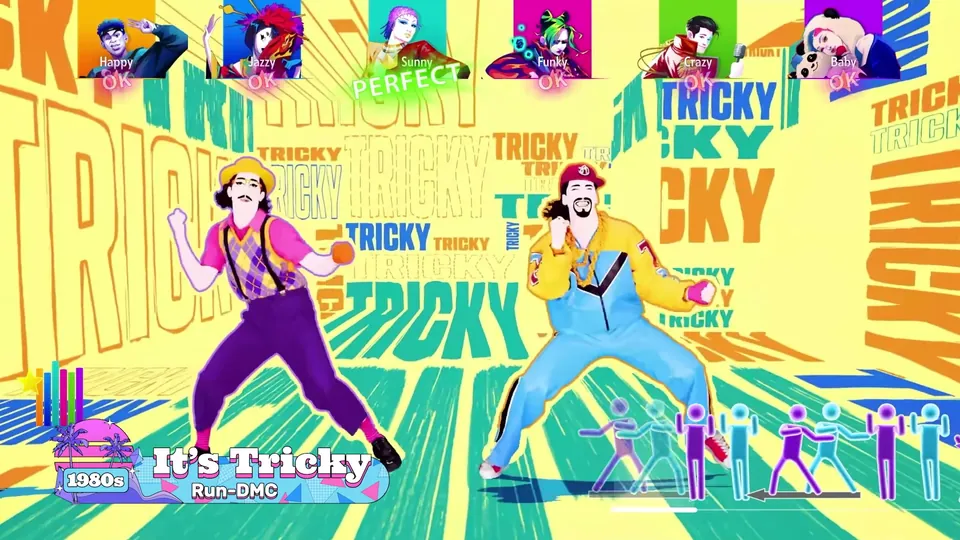
Official Ubisoft in-game screenshot.
Stage one: prove the setup works
Uptown Girl (Billy Joel, Solo). Slow, big arm shapes, forgiving timing. It exists in this list as a diagnostic as much as a song — if it scores badly, the problem is your television or phone placement, not you. Play it first every evening you change anything about the room.
Coconut (SMiLE.dk, Duet). Short and light. The point is the duet structure: you learn which dancer you are and where your lane is, without any choreography pressure.
Stage two: learn to read the screen
Mamma Mia (ABBA, Duet). A repeating chorus at a slow tempo, plus the trick that matters forever: the ghost trail shows the next move. If you are still watching the coach's body instead of the trail, this is the song to break the habit on.
**Bye Bye Bye (*NSYNC, Trio).** Three lanes, clean choreography, highly copyable. It is the best teaching routine in the game for lane discipline — with three dancers you cannot fake your position.
Celebration (Kool & the Gang, Solo). A solo whose chorus the whole room can copy. Use it to practise holding a pose until the trail moves rather than leaving early.
Stage three: the 2000s block
Six tracks, four of them multi-dancer, none rated Extreme — the highest-quality teaching block in the game.
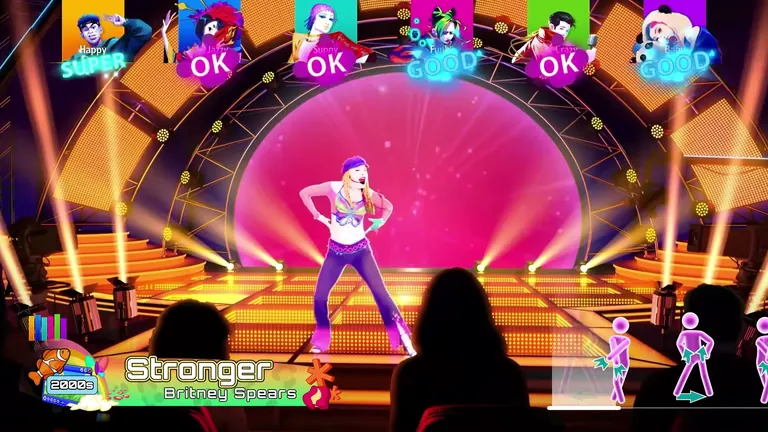
Stronger (Britney Spears, Solo). The prop-driven staging of the base routine makes you think about shape rather than just timing. No Scrubs (TLC, Trio). Mid-tempo trio; the lane discipline from Bye Bye Bye pays off here. Starlight (The Supermen Lovers, Duet). The block's easiest duet and a good bridge to faster material. In Too Deep (Sum 41, Quartet). Your first quartet. Four lanes, punk tempo, and a genuine step up. Feel Good Inc. (Gorillaz, Solo). Moody and mid-tempo; a useful solo to test whether your arms are being read on smaller movements.
Stage four: the 2010s
Just a Girl (No Doubt, Duet). Punchy and readable, and it teaches the duet split properly. Hello (Martin Solveig & Dragonette, Duet). Mid-tempo with the most accessible alternate in the game (Video Call) once you want a second look at the song. Santa Tell Me (Ariana Grande, Solo). Gentle effort rating, good for a cooldown that still counts as practice. Give Me Everything (Pitbull ft. Ne-Yo, Afrojack & Nayer, Trio). Steady club tempo across three lanes.
Stage five: the 2020s
HOT TO GO! (Chappell Roan, Solo). The block's friendliest opener and its most popular routine. Manchild (Sabrina Carpenter, Solo). Moderate effort, strong chorus movement, a good step before the hard material. Then stop. MORE & MORE and Midnight Sun are rated at the top of the game's range — see the difficulty page — and they are much less frustrating after the rest of the tracklist.
What to skip while learning
Danza Kuduro. Fast footwork, the routine most often called unfair. It is a great song to arrive at, not to start on.
Jump. Rated intense with continuous upper-body work. It is the best exercise track in the game and a bad first week.
The two Extreme alternates. Wannabe Extreme and NUEVAYoL Extreme are the hardest entries in the game. The alternates guide explains what they change.
Making the ladder stick
Play each stage in order across two or three sessions rather than all of it in one evening, and replay the diagnostic song — Uptown Girl — whenever scores start feeling random. The scoring page explains what to fix once the trail is second nature, and the TV setup page covers the half of the problem that is not you.